
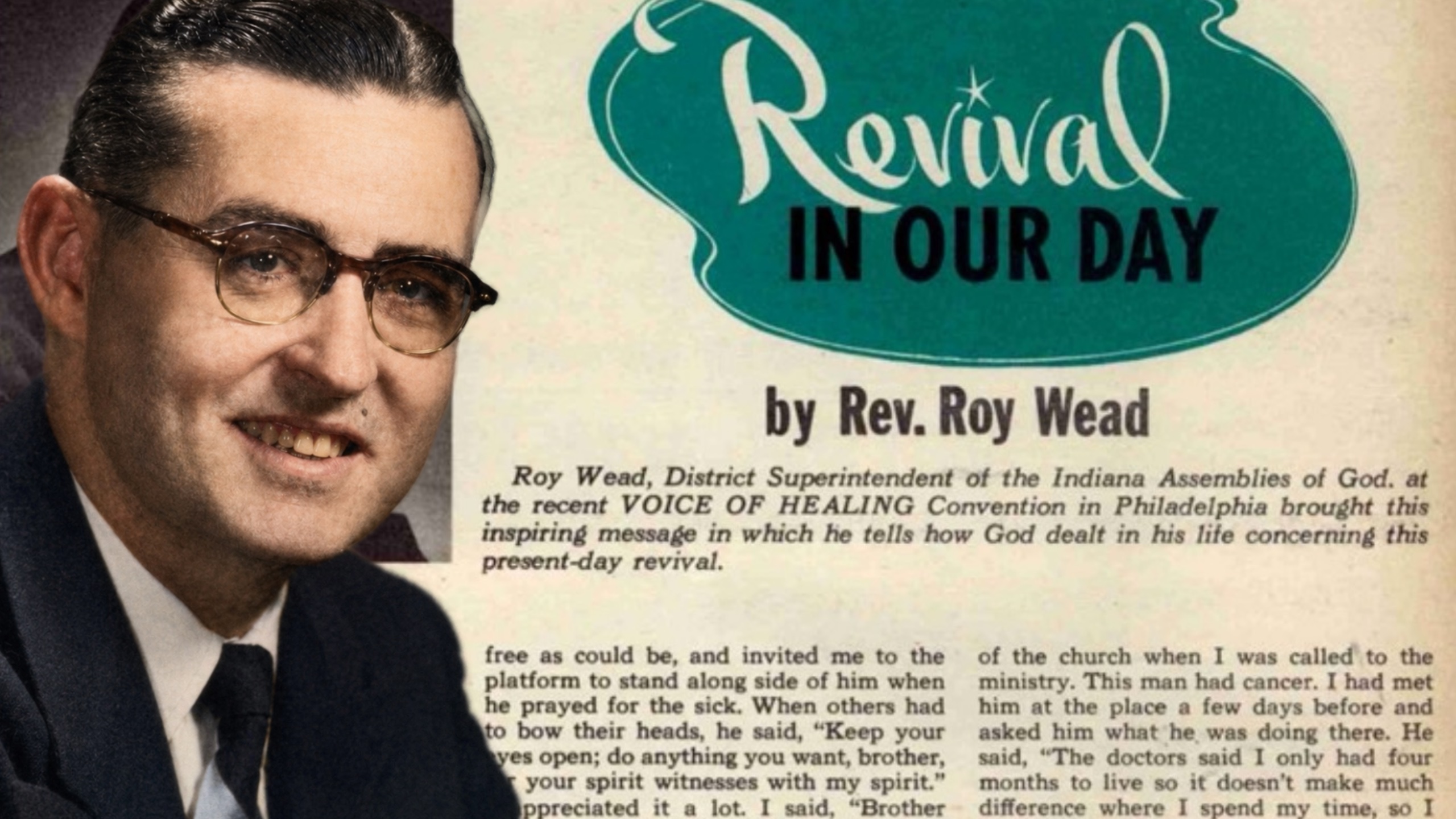
Roy H. Wead
Roy H. Wead was an Assemblies of God minister, educator, and charismatic leader whose work connected classical Pentecostalism with later charismatic renewal, especially through teaching, leadership, missions, and institutions that helped carry Pentecostal doctrine and experience into broader evangelical and charismatic settings, making him part of the wider network of figures who bridged older denominational Pentecostalism with the expanding renewal movements of the mid-to-late twentieth century.
Roy H. Wead was the First District Superintendent for the Assemblies of God in Indiana. Wead was the youth and missions director for Ohio and Indiana, well known by most of the pastors in the state.[1] His son, Doug Wead, was an advisor for two American presidents and a special assistant to George H. W. Bush. Wead was married to Rosa Mae Short, daughter of famous Pentecostal evangelist Willa J. Short who falsely posed as a widow during her ministry in Texas.[2]
During Wead's thirteen years as Indiana District Superintendent for the Assemblies, Indiana experienced the fastest growth in the nation. A new church was opened every month for all thirteen years.[3] In 1952 Wead moved the headquarters of the Indiana district from Terre Haute to Indianapolis.[4] Under his leadership, Indiana Assemblies of God were more lenient towards "faith healers" than other states, and Indiana was considered to be a "rogue district that was too tolerant."[5] In 1949 when the Assemblies of God passed a resolution against the Latter Rain movement[6] and Voice of Healing movement,[7] Wead defended the movement on the floor of the national convention.[8]
That same year, Wead dedicated the Laurel Street Tabernacle in Indianapolis,[9] where Jim Jones would be recruited into Branham's "Message" cult following. Lester Sumrall, who was also involved with Branham's healing revivals,[10] joined Wead to hold a series of revivals. As would any church affiliated with the Branham healing revivals, the Laurel Street Tabernacle often advertised healing meetings.[11] The Laurel Street Tabernacle eventually attracted Jim Jones, Jones began preaching and continued to do so until he became a familiar face in the Laurel Street Tabernacle.[12] Whether directly or indirectly through Wead and others sympathetic to Branham's movement at the Tabernacle, Jones would eventually become a "Message" minister.[13]
In 1955, shortly before the Assemblies of God halted Jim Jones from preaching at the Laurel Street Tabernacle,[14] Wead spoke at a Voice of Healing convention in Philadelphia declaring his allegiance to the "present-day revival". His message was also published in a letter to Branham's followers through The Voice of Healing [15] According to Wead, it was "God's plan that all hear this Message", and in one church "about seven thousand people come to worship and hear the glorious Message." [16] Wead said that the South American missions "revolutionized" his life — a term that Jim Jones would later use[17] for his own South American sect at Jonestown. During his speech at the convention, Wead went on to describe the spreading of Branham's "Message" sect around other parts of the world. One, in particular, had changed his mind about going to Africa and decided instead on South America. According to Wead, thousands of people in South America were being recruited into "the Message".[18]
I pray that somehow God will lead these brethren, help them to do something to take care of that tremendous need. Somebody is going to do it. It is divine order. It is in God's plan that every individual shall be reached by this glorious Message. If we don't do it, God will do it through somebody else.
- Roy Wead, at the 1955 Voice of Healing Convention[19]
William Branham mentioned the schism in Pentecostalism that resulted from the Latter Rain movement, praising Roy Wead.[20]