
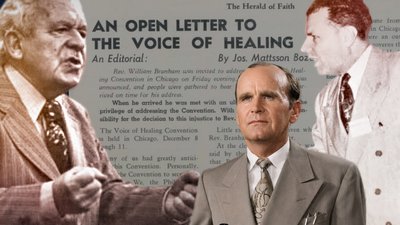
1953 Voice of Healing Convention
The 1953-1955 rupture between William Branham and The Voice of Healing marked a major turning point in the postwar healing revival, as Ern Baxter, Gordon Lindsay, and other revival leaders distanced themselves from Branham over doctrinal concerns, while Joseph Mattsson-Boze and the Latter Rain wing defended him, promoted him through The Herald of Faith, and rebuilt his influence through a new fellowship of sympathetic ministers; into this realignment came Jim Jones, who by 1955 was being publicly promoted by Boze as a gifted healing and discernment minister within the Herald of Faith network, placing Peoples Temple inside the same Branham-aligned, Latter Rain revival stream that emerged after Branham's rejection by the Voice of Healing establishment.
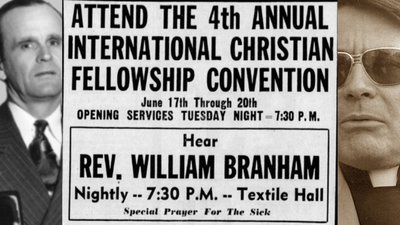
Brotherhood Healing Crusade: Joseph Mattsson-Boze, William Branham, and a Rival Revival Network
In the mid-1950s, William Branham’s rupture with his campaign leadership and the Voice of Healing intersected with Jim Jones’ formation of Peoples Temple, producing a short-lived alliance centered on the Brotherhood Healing Crusade and related Christian Fellowship Conventions. The naming strategies, publications, and personnel involved reveal how revivalist rivalries, doctrinal disputes, and organizational schisms shaped Jones’ early trajectory and Branham’s post-Voice of Healing network.
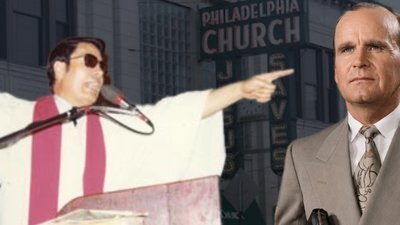
Jim Jones
Jim Jones was the founder and leader of Peoples Temple, a religious-political movement that began with promises of racial equality, social justice, communal care, and protection for the vulnerable, but gradually became an authoritarian system centered on Jones's control, paranoia, loyalty demands, isolation, abuse, and apocalyptic fear, ultimately ending in the 1978 Jonestown tragedy, where more than 900 people died in one of the clearest modern examples of spiritual manipulation, coercive leadership, and catastrophic communal collapse.
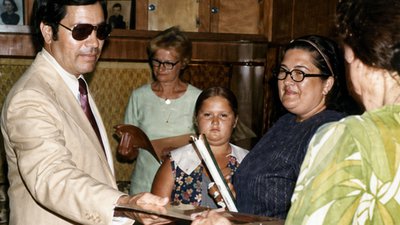
Jim Jones' Prophecy About William Branham
Jim Jones's break with William Branham appears to have followed his brief period as a Branham-aligned "Message" and Latter Rain leader in 1956-1957, when Jones worked with Branham and Joseph Mattsson-Boze before later claiming that Branham privately admitted disbelief in the Bible, pressured him to avoid unpopular doctrines, and warned him against preaching the truth; in Jones's later retelling, the rupture centered on Branham's developing Third Pull, Manifested Sons of God, and reincarnation-like Elijah theology, which Jones rejected while placing a curse on Branham's death, showing how Peoples Temple both emerged from Branham's healing revival network and then split from it while retaining dangerous strands of apocalyptic, prophetic, and authoritarian theology.
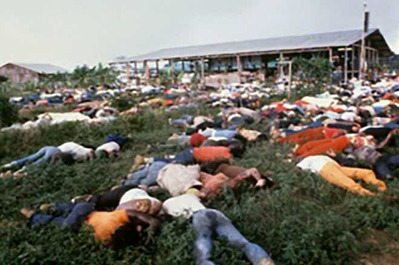
Jonestown Massacre
The Jonestown Massacre was the 1978 mass death of more than 900 members of Jim Jones's Peoples Temple in Guyana, following years of authoritarian control, isolation, apocalyptic fear, political-religious manipulation, and escalating abuse within a movement that had begun with promises of racial equality and social justice but collapsed into paranoia, coercion, murder, and forced mass suicide after Congressman Leo Ryan's investigative visit triggered Jones's final act of control over the community.
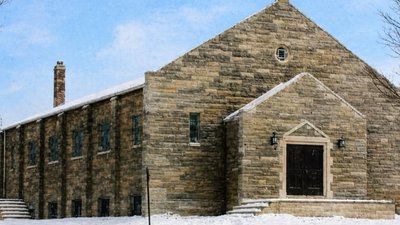
Laurel Street Tabernacle
Laurel Street Tabernacle in Indianapolis appears to have been a key gateway through which Jim Jones entered William Branham's "Message" and Latter Rain healing revival network, beginning as an Assemblies of God congregation with strong evangelistic and divine-healing emphasis, hosting figures such as Roy Wead and Lester Sumrall, and later providing Jones a platform after he turned his Somerset Methodist congregation into a Full Gospel assembly, with newspaper advertisements showing him ministering at Laurel Street and uniting with its "mighty move of God," suggesting that the church helped connect Jones to Branham-aligned leaders, Independent Assemblies of God circles, and the postwar healing revival world that shaped the early Peoples Temple.
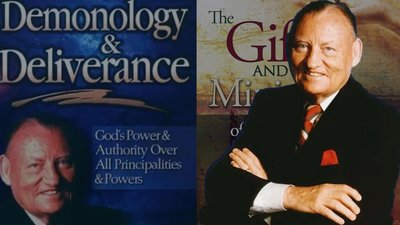
Lester Sumrall
Lester Sumrall was a Pentecostal evangelist, missionary, author, broadcaster, and deliverance minister whose work connected mid-twentieth-century healing revival culture with later charismatic emphases on spiritual warfare, demons, miracles, missions, media ministry, and global revival, making him an influential figure in modern Pentecostal and charismatic networks while also reflecting the movement's broader tensions around supernatural authority, healing claims, demonology, and personality-driven ministry.
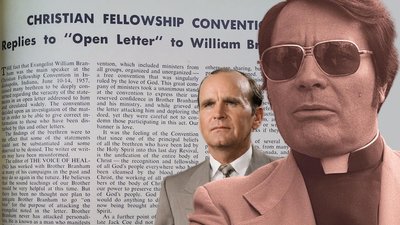
Peoples Temple: Open Letter to William Branham
The final convention that Jim Jones and Peoples Temple held with William Branham in June of 1957 did not share the same success as the prior meetings Jones held with William Branham and Joseph Mattsson-Boze in Indianapolis, Chicago, and other cities. After the June 1957 meeting, several Voice of Healing evangelists revolted against Branham and sent an open letter condemning him. The letter was circulated among several evangelists, and a copy was sent to Branham's Voice of Healing editors. Voice of Healing launched an internal investigation, and announced it in an article entitled "CHRISTIAN FELLOWSHIP CONVENTION Replies to 'Open Letter' to William Branham."
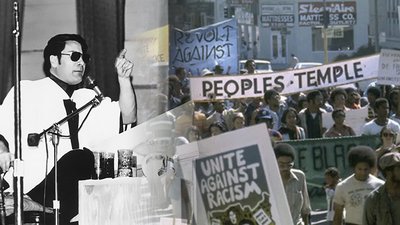
Peoples Temple: The Church Split That Changed History
Laurel Street Tabernacle became a pivotal Indianapolis bridge between classical Assemblies of God Pentecostalism, the postwar healing revival, the Latter Rain controversy, William Branham's "Message" network, and the early formation of Peoples Temple, as the small but influential church promoted divine healing, hosted revival figures such as Roy Wead and Lester Sumrall, gave Jim Jones a platform after he moved from Methodism into Full Gospel circles, and then became the setting for a split in which Jones gathered followers, accepted Independent Assemblies of God ordination through Joseph Mattsson-Boze, and launched Peoples Temple into the Branham-aligned healing revival world that culminated in the 1956 Cadle Tabernacle crusade with Branham.
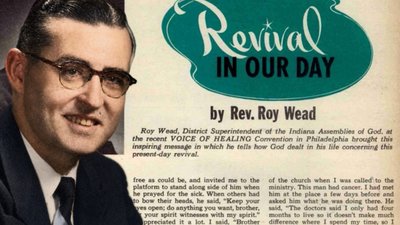
Roy H. Wead
Roy H. Wead was an Assemblies of God minister, educator, and charismatic leader whose work connected classical Pentecostalism with later charismatic renewal, especially through teaching, leadership, missions, and institutions that helped carry Pentecostal doctrine and experience into broader evangelical and charismatic settings, making him part of the wider network of figures who bridged older denominational Pentecostalism with the expanding renewal movements of the mid-to-late twentieth century.
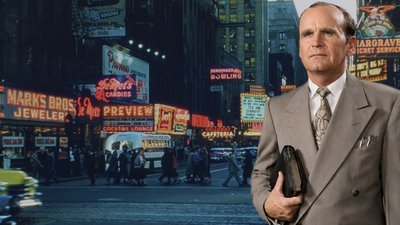
The Chicago Bombing Prophecy
The Chicago Bombing Prophecy refers to William Branham's claim that the Old Testament prophet Nahum had not prophesied the destruction of ancient Nineveh, as the biblical text states, but had instead foreseen modern Chicago's Outer Drive and the city's eventual destruction by nuclear attack, a reinterpretation that grew from speculative Cold War doomsday preaching into a more definite prophetic warning and appears to have influenced Jim Jones, who repeated similar apocalyptic claims to Peoples Temple followers and later incorporated visions of nuclear destruction, UFO-related revelation, and survival theology into the fear-based worldview that helped drive the movement toward isolation, paranoia, and the Jonestown catastrophe.
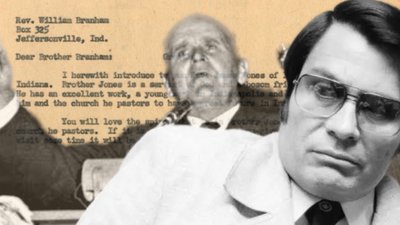
William Branham's Introduction to Jim Jones
Rev. Jim Jones of Peoples Temple was personally connected to Jim Jones. As a ranking leader of Branham's "Message" sect, Jones had direct access to Branham by phone and instructions on how to quickly access Branham by mail. The introduction came through two letters.
No records found.