
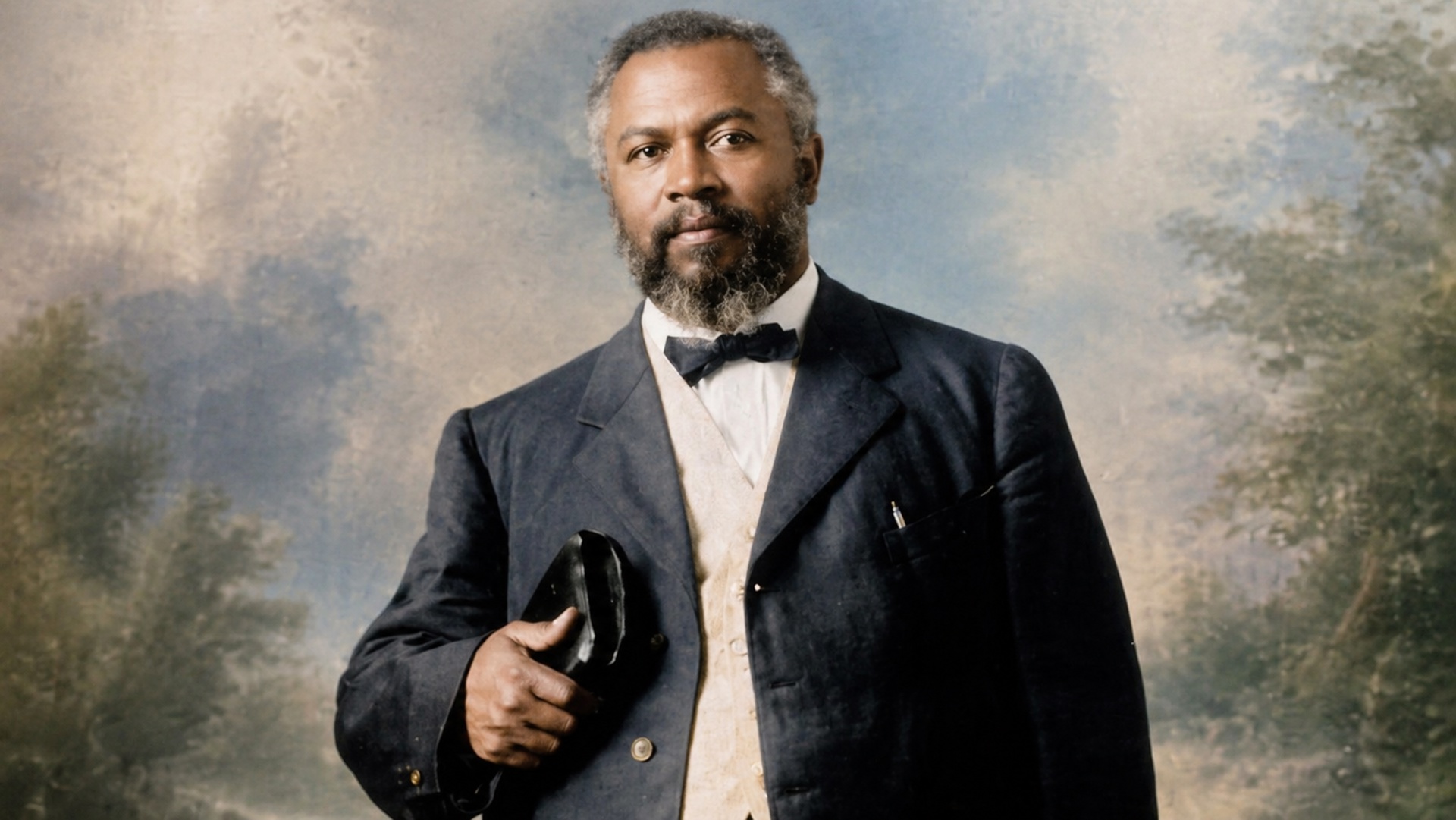
William Seymour
William J. Seymour was the African American Holiness minister whose leadership at the Azusa Street Revival helped launch modern Pentecostalism, but his path to Los Angeles passed through a complex world of radical holiness sects, end-time expectation, divine-healing houses, Charles Fox Parham's segregated Apostolic Faith teaching, Lucy Farrow's influence, and the search for Spirit baptism evidenced by tongues; after being rejected by Julia Hutchins's Holiness mission, Seymour began meetings in the Asbery home on Bonnie Brae Street, where ecstatic experiences spread into the Azusa Street mission and drew interracial crowds, Holiness seekers, occult observers, critics, and national attention, creating a chaotic but historically decisive revival that broke with Parham over race, spiritual disorder, and authority while sending converts back across the country to form many of the denominations and practices that became early Pentecostalism.
William Joseph Seymour was born to freed slaves Simon and Phyllis Seymour in Centerville, Louisiana.[1] In the 1890s, during the height of Dowie’s highly publicized ministry, Seymour traveled north on a journey of spiritual enlightenment through Memphis, St. Louis, and eventually Indianapolis, Indiana. There, he converted from the Roman Catholic Church to the Protestant faith through a Methodist church. Seymour was not fully committed to the Methodists, however, and was soon influenced into the Holiness faith through Daniel S. Warner’s “Evening Light Saints” sect just outside of Indianapolis. The “Evening Light Saints” was a radical Holiness group that focused heavily on the End of Days, basing their theology upon a verse in the book of Zechariah, Chapter 14 verse 7: "at evening time it shall be light."[2] The peculiar sect considered their abstinence from coffee, tobacco, and modern clothing styles to be part of this “evening light.” Declaring that the End of Days was drawing near, they believed that their “light” was shining on those about to suffer the consequences of doomsday. It was in this sect that Seymour was ordained to be a minister.[3]
After his ordination, Seymour traveled the country, still searching. For a few years, Seymour attended a school in the Holiness sect founded by Martin Wells Knapp in Cincinnati, OH. Under Knapp’s instruction, Seymour was influenced to believe that “special revelation” was vitally important to the faith. According to Knapp, a person either received “impressions” from God or “impressions” from Satan. He authored a book of this title, attempting to spread his own version of the Holiness faith. But when the city was struck with a smallpox plague, Seymour contracted the disease, which would result in the loss of one eye. Seymour later considered this event his “chastisement,” and traveled to the “healing houses” in Zion City. It was there Seymour came in contact with John G. Lake, a healing evangelist, and John Alexander Dowie, the already famous healer, and leader of Zion. From 1903 through 1905, Seymour made Houston his base of operations.[4]
Seymour was a close friend of Lucy F. Farrow, who was a governess and a cook in Charles Fox Parham’s commune in Topeka, KS. Farrow was also born into slavery, in Norfolk, Virginia, and made news throughout the rising Holiness sects when she became the first African American to experience glossolalia under the influence of Charles Fox Parham.[5] She was the pastor of a small Holiness church in Houston when Parham arrived to establish his sect and participated when Parham held a recruiting crusade in the Bryn Hall in downtown Houston. In a short time, both Farrow and Seymour became regular attendees in Seymour’s meetings in Houston.[6] Seymour had been leading her church during her absences to assist Parham, and it is said that it was Farrow who convinced William Seymour to join Parham’s school in Houston, Texas.[7]
Seymour’s time in the school was only very brief, however, as he stayed there for only a few weeks. Some aspects of Parham’s new sect were unsettling to many, including Seymour. It was no secret that Parham was among the numerous “prophets” plaguing Chicago in an attempt to gain John Alexander Dowie’s throne and fortune. This made him appear much more like an opportunist than a spiritual leader. Worse, it was obvious that Parham did not consider the African American race to be equal with his own; Parham’s meetings were segregated, with whites gaining the primary seats in auditoriums and sanctuaries. African Americans were forced to sit or stand in the rear during the meetings. Neely Terry, a Los Angeles native in Houston visiting Lucy Farrow, befriended Seymour and described an African American Holiness mission she was creating in Los Angeles. With the unsettling feelings he was having with Parham’s sect, Seymour began to show interest.[8] In February of 1906, Seymour was asked to pastor the mission, and he quit Parham’s school to relocate.[9]
Interestingly, Seymour did not go directly to Los Angeles. It would appear that he was attempting to gain a following to migrate with him. Along the way, he decided to stop at several well-known and established Holiness sects. One such stop was in Denver, Colorado, at a Holiness sect called the “Pillar of Fire Movement” led by Alma White. This sect “specialized” in the “holy dance,” and White taught her converts that the strange act of spiritual ecstasy was “evidence” of the Holy Spirit in their sect. White, taking a similar stance against the Methodist denomination, railed against the Methodist Church, claiming they were corrupt. But like Parham, her views on racism and nativism were a fundamental part of her doctrine. As a result, Seymour was not well received.[10] White later described Seymour as a “very untidy person,” who was seeking to create his own following. In her book, Demons and Tongues, she claimed she had “met all kinds of religious fakers and tramps, but [I] felt he excelled them all.”[11]
When Seymour arrived in Los Angeles, the religious landscape had changed quite a bit from the time when John Alexander Dowie was making headlines. Los Angeles was home to a growing number of Holiness converts. Like the “Pillar of Fire Movement,” the Holiness groups of Los Angeles were not aligned with the new doctrines coming from the East. Many had not even heard of Parham’s teaching on glossolalia, and did not hold the teachings of Frank Sandford or John Alexander Dowie with the same respect as Seymour had appreciated in Houston.
Similar to his experience with the “Pillar of Fire” sect, Seymour’s reception at Terry’s Holiness mission in Los Angeles was very cold. Using Parham’s teaching on “speaking in tongues” being “evidence of the Holy Ghost,” Seymour opened his first sermon with Parham’s key passage of text from the New Testament of the Christian Bible, Acts 2:4. This was very concerning for one Mrs. Julia Hutchins, and she began to examine his statements. After consulting with the president of the Southern California Holiness Association, she felt that the doctrine Seymour had learned from Parham’s sect was contrary to the accepted Holiness views. Immediately, she padlocked the doors of the church to keep Seymour out. With no money for food or lodging, Seymour found himself at the mercy of the people. He began pleading with them for room and board. Fortunately, one of the members of the congregation invited him to stay, and Seymour found himself lodging at the home of Richard Asbery, of 214 Bonnie Brae Street.
Seymour, not swayed by losing the position he sought in the Holiness mission, began preaching in the living room of Asbury’s home. When the house started filling with people, he suddenly realized that many in Terry’s Holiness mission had become curious enough to hear more of Parham’s teaching – even after only having heard one single sermon. He continued preaching in Asbery’s house and on the night of April 9, 1906, he had fulfilled Parham’s plan of “evidence.” Seymour and seven others fell to the floor in religious ecstasy, speaking in tongues. Asbery’s daughter fled the house, absolutely terrified of what she had seen.[12]
The religious ecstasy continued day and night. Seymour’s future wife Jennie Moore began to play the piano and sing in what others claimed to be Hebrew, while demonstrations of glossolalia spread quickly to others in the house. Word of the strange events quickly traveled through Los Angeles and beyond. Before long, Holiness converts and curious others came to see the commotion. So many came, in fact, that Seymour was forced to create a makeshift pulpit on the porch after the floor of Asbery’s house caved in.[13] Suddenly, Seymour found himself leading the “worship” in a mixed crowd of blacks and whites, without the segregation he had experienced in Parham’s meetings.
The commotion increased even more on April 18, 1906 when the San Andreas fault violently settled and the city of San Francisco was set ablaze.[14] The religious fanatics throughout Los Angeles began claiming that judgment had struck the west coast, and the wrath of God was about to consume the nation. As a result, Holiness groups far and wide began churning out tracts and pamphlets warning that the End of Days was near.[15] By evening, news of Seymour’s new revival had reached the newspapers. The Los Angeles Times ran a front-page article describing a “New Sect of Fanatics” that was “Breaking Loose” with a “Weird Babel of Tongues.”
Colored people and a sprinkling of whites compose the congregation, and night is made hideous in the neighborhood by the howlings of the worshipers, who spend hours swaying forth and back in a nerve-racking attitude of prayer and supplication. They claim to have “the gift of tongues,” and to be able to comprehend the babel. Such a startling claim has never yet been made by any company of fanatics, even in Los Angeles, the home of almost numberless creeds. Sacred tenets, reverently mentioned by the orthodox believer, are dealt with in a familiar, if not irreverent, manner by these latest religionists.”[16]
Los Angeles Times
An old colored exhorter, blind in one eye, is the major-domo of the company. With his stony optic fixed on some luckless unbeliever, the old man yells his defiance and challenges an answer. Anathemas are heaped upon him who shall dare to gainsay the utterances of the preacher. Clasped in his big fist the colored brother holds a miniature Bible from which he reads at intervals one or two words – never more. After an hour spent in exhortation the brethren present are invited to join in a “meeting of prayer, song and testimony.” Then is that pandemonium breaks loose, and the bounds of reason are passed by those who are “filled with the spirit,” whatever that may be. “You-oo-oo gou-loo-loo,” shouts come under the bloo-oo-oo boo-loo,” shouts an old colored “mammy,” in a frenzy of religious zeal. Swinging her arms wildly about her she continues with the strangest harangue ever uttered. Few of her words are intelligible, and for the most part her testimony contains the most outrageous jumble of syllables, which are listened to with awe by the company.[17]
Against the better wishes of J. M. Roberts and the Southern California Holiness Association, many local Holiness Churches began to join Seymour’s “revival.” Each group, having their own practice of religious ecstasy they claimed to be “evidence of the Holy Ghost,” began performing their ritual. Soon, groups practicing the “holy jerks,” the “holy laughter,” the “holy dancing,” the “singing in the spirit,” the “speaking in tongues,” and more filled Azusa Street. This widespread display of religious zeal began to attract non-Christian groups as well. Holiness converts believing their specific form of ecstasy was “evidence of the Holy Ghost” suddenly found themselves standing next to spiritualists, mediums, and even the numerous occult societies of Los Angeles. Before long, the Azusa Street Revival was home to occult séances and trances mixed with strangely similar “Christian” séances and trances. Having been taught that these experiences were “evidence of the Holy Ghost,” Seymour was very confused. So, he wrote letters to Parham for advice, asking how to tell the occult ecstasy from the Christian ecstasy.[18] While he waited for a response, hundreds of religious fanatics – Christian and occult alike – filled Azusa Street with noise and commotion twenty-four hours a day, seven days a week.
One visitor described the revival as pure chaos. Men and women were shouting, weeping, dancing, falling into trances, speaking and singing in tongues, all while “Elder” Seymour leading the “revival” rarely preached. Most of the time, Seymour kept his head covered by a packing crate behind the pulpit. When he was seen walking through the crowds, five-and-ten-dollar bills were sticking out of his hip pickets where passersby had crammed them full of money. When he preached, he hurled insults and challenges to anyone who did not accept his views. To those who accepted his “message,” Seymour would exclaim, “Be emphatic! Ask for salvation, entire sanctification, the baptism with the Holy Ghost, or divine healing!”[19]
When Charles Fox Parham finally arrived in Los Angeles on October of 1906 after having been ex-communicated from Zion City, he was shocked to find the interracial unity of the revival. He described the meetings, claiming the people were “all crowded together around the altar, and laying across one another like hogs, blacks and whites mingling; this should be enough to bring a blush of shame to devils, let alone angels, and yet all this was charged to the Holy Spirit.”[20]
This is confirmed by Nettie Harwood, a critic of the Azusa Street Revival and disciple of Alma White. After visiting the mission in late 1906, she reported that there was much kissing between the sexes and even races. She was appalled at seeing an African American woman with her arms around a white man’s neck praying for him. Having been taught White’s doctrine on the purity of races, she considered Seymour an “instrument of Satan.”
Though Seymour claimed Parham was his “Father in the Gospel of the Kingdom,” Seymour’s converts saw Parham’s objections as threats. Some of them told Seymour that Parham “was not wanted in that place.” Their anger increased even more after his harsh statements against the hypnotists and spiritualists that had taken over the services. Eventually, Seymour himself banned Parham from the revival meetings, which had ironically named itself the “Apostolic Faith Gospel Mission” after Parham’s own organization. For spite, Parham opened competing meetings at a local W.C.T.U. building on the corner of Broadway and Temple Streets, less than a mile away.[21] He was unable to compete with the circus at Azusa Street, however, and eventually retreated back to Houston.
That which had started as Charles Fox Parham’s original attempt to recreate a new sect based upon militaristic qualities from Reverend Frank Sandford and John Alexander Dowie’s communes ended up being a loose cannon that blasted Holiness sects and organizations throughout the country. Most of the people in the Holiness faith who visited the Azusa Street Revival returned to their cities convinced they had the “gift,” as well as the ability to give it. Many who attended, even for a short period of time, later founded entire denominations of Pentecostal believers, and a list of “pilgrims to Los Angeles” eventually became list of “who’s who” in early Pentecostal leadership.[22]