
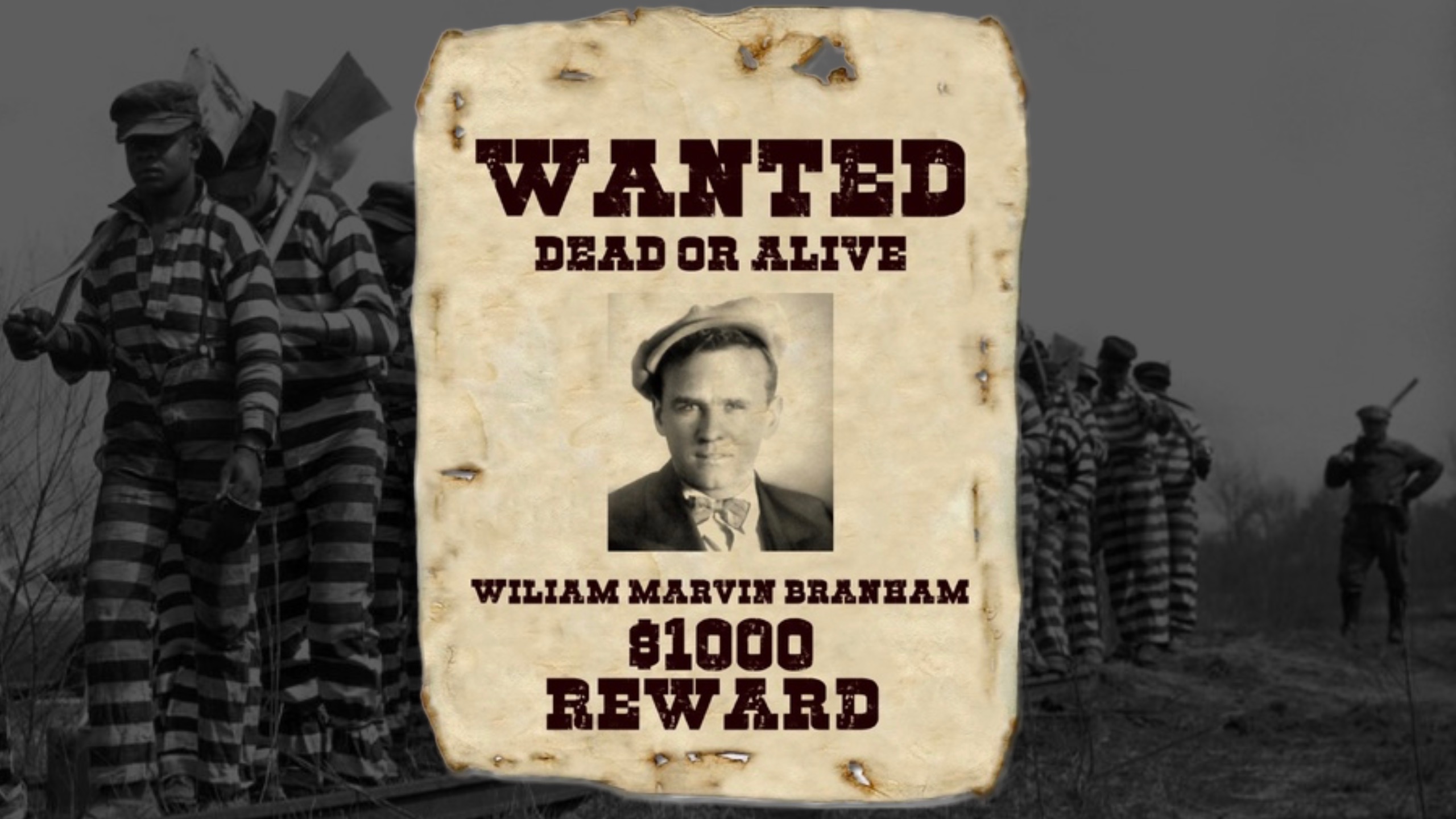
Change of Identity or Stage Persona? What the Records Show About William Branham
Contemporary newspapers, court records, census data, and federal draft registration demonstrate that William Branham’s identity remained stable and publicly traceable through the Prohibition era and into adulthood, despite significant criminal activity and instability within his family. Later name variations—most notably the use of “Henry Branham” and the shift from Marvin to Marrion—align with the construction of a revival-stage persona rather than an attempt to evade law enforcement or conceal his past.
Contemporary newspaper coverage establishes that Charles Branham, the father of William Branham, was repeatedly arrested, convicted, and incarcerated for violations of Prohibition-era liquor laws in the early to mid-1920s. In March 1924, law enforcement officers raided the Branham property, discovered a still and illicit alcohol, and arrested Charles Branham, who admitted he was acting in violation of the law [1]. Shortly thereafter, he pleaded guilty and was sentenced to serve time in jail, with arrangements made for him to work nights while incarcerated [2]. William Branham openly admitted that he participated in the crime.
Later we moved to Indiana and Father went to work for a man, Mr. Wathen, a rich man. He owns the Wathen Distilleries. And he owned a great shares; he's a multimillionaire, and the Louisville Colonels, and—and baseball, and so forth. And then we lived near there. And Dad being a poor man, yet he could not do without his drinking, so he—he went to making whiskey in a—in a still. 61 And then it worked a hardship on me because I was the oldest of the children. I had to come and pack water to this still, to keep those coils cool while they were making the whiskey. Then he got to selling it, and then he got two or three of those stills. Now, that's the part I don't like to tell, but it's the truth.
- Wililam Branham, Apr 4 1959. My Life Story
These legal troubles had direct and documented consequences for the Branham household. A March 1924 hospital billing notice for William Branham explicitly linked his medical treatment to the family's financial and legal distress, noting that his father had been convicted and jailed for manufacturing intoxicating liquor and concluding that "the family is destitute" [3]. The same Jeffersonville address appears repeatedly in court and newspaper records, indicating that the family remained visible to local authorities rather than disappearing from public record.
This pattern of arrests, convictions, fines, and incarceration continued into the later 1920s, culminating in additional sentencing to the state farm in 1927. The cumulative record demonstrates sustained legal pressure and social instability within the Branham household during William Branham's adolescence. While these facts do not, by themselves, establish that William Branham later changed his name to evade the law, they do document an environment in which legal scrutiny, stigma, and economic hardship were persistent and publicly recorded. However, Branham publicly admitted that he left Jeffersonville shortly after his father's arrest and before being sentenced to the state farm for violating liquor laws.
I was passing down this street. I come here the first time, thirty-five years ago, this year, 1926, in old T-model Ford. And I lived at Sixteenth and Henshaw
- William Branham, Jan 17, 1962 Presuming
William Branham's Name Variations
Records from the early twentieth century show that variation in given names and initials was not unusual within the Branham family and appears consistently across civil, census, and newspaper sources. Census records from 1910, 1920, and 1930 list William Branham within the household of Charles Branham using standard family naming conventions, without any indication of aliasing or concealment. These enumerations place the family repeatedly in Clark County, Indiana, demonstrating continuity of residence rather than disappearance or flight [4]. To this point in history, William Branham's official name was "William Marvin Branham."
Branham's 1940 Selective Service registration provides a formal, government-verified identity. The card lists his full name as William Marvin Branham, gives a precise date and place of birth, and includes physical descriptors and employer information, all attested by signature. This document establishes that, at least in official federal records, Branham was using his legal name and middle name "Marvin" well into adulthood [5]. He later used "Marrion" for his stage persona, suggesting that the seven letters were spiritually significant as "God's complete number" and that the six letters were insignificant as "man's number." He therefore changed his name for his stage persona to "Marrion" (adding an extra "r" to the common name "Marion").
And there was a denominational group down in Sodom, and a Billy Graham and a Oral Roberts went down there. And remember as I've told you, nowhere in the history of the church has there ever been a messenger sent universal to the church, until now, with his name ending like Abraham, h-a-m. G-r-a-h-a-m, six letters, to the world, man's number. But Abraham had seven letters in the name, God's complete and perfect number
- WIlliam Branham 1965, Nov 27. I Have Heard But Now I See
There is many Branhams, if you want to talk about me personally, but I'm—I'm the one William Marrion Branham. That—that's me. But there's many other William Branhams, and so forth, around.
- WIlliam Branham, 1963, March 24. Questions And Answers On The Seals
Interestingly, his usage of the name "Henry Branham" (which was his brother's name) appears in multiple public contexts that are chronologically separate from the family's earlier legal troubles. 1940 Courier-Journal boxing articles list his brother Henry competing in a bantamweight match. [6] Multiple 1947 newspaper reports and feature articles identify William Branham as "Henry Branham," including a full-page magazine profile describing his healing meetings and public ministry [7]. Some evidence suggests that William attempted to use Henry's fame to build a ministry; William claimed Henry's boxing titles throughout his recorded ministry.
I won the Bantamweight Championship a few years ago in boxing.
- William Branham. May 9, 1951. Testimony
What the Census Record Shows
Federal census records from 1910, 1920, and 1930 provide a continuous paper trail for the Branham family that shows stability of surname and household composition rather than fragmentation or disappearance. In the 1910 census, the Branham household is enumerated under the family name with Charles Branham as head of household, and the children listed consistently by given name and age within the expected ranges for the period [8].
The 1920 census continues this pattern, placing the Branham family in Clark County, Indiana, with William Branham still residing in the household. In the 1930 census, William Branham is again enumerated in Clark County, maintaining continuity of surname, family association, and geographic location [10]. Across all three census decades, the family remains visible to civil authorities and enumerators. Taken together, the census evidence demonstrates that, through 1930, William Branham's identity was stable, traceable, and publicly recorded under his birth name.
They do, however, undermine the Kentucky childhood tales Branham used for his stage persona. In his "Life Story" accounts, Branham often told of his siblings in a log cabin in Kentucky, raised by a widowed mother. Census records show all but one of his siblings were born in and lived in Indiana.
The Death of Edward
The death of Edward W. Branham in 1929 provides additional context for evaluating identity consistency within the Branham family and for assessing later retrospective claims made by William Branham. Contemporary newspaper reporting described Edward as nineteen years old at the time of his death and explicitly identified him as the son of Charles Branham, who resided in Clark County, Indiana [11]. The report situates the event within the same household and geographic setting documented in census and court records from the surrounding years. The official Indiana State Board of Health certificate of death corroborates the occurrence of Edward Branham's death in June 1929 and supplies formal civil documentation of the event [12]. Edward adds additional complexity due to the fact that he was charged with first-degree murder after a gun battle in 1928. Multiple members of the Branham family were criminals.
Selective Service Registration and Formal Identity (1940)
William Branham's Selective Service registration card, completed in October 1940, represents the most authoritative and legally consequential identity document in the existing record. The draft card lists his full legal name as William Marvin Branham, provides a specific date and place of birth, and records his residence, employer, and physical characteristics [13]. The information was supplied under federal authority at a time when false statements could result in criminal penalties, making deliberate misrepresentation unlikely.
The draft registration is significant because it postdates the period of family legal trouble in the 1920s by more than a decade and predates Branham's emergence as a nationally known healing evangelist. At this point, there is no evidence of alias usage, name substitution, or ambiguity. The middle name "Marvin" appears here in a formal federal context, confirming that it was his operative legal middle name at the time.
This document also undermines claims that Branham was concealing his identity or avoiding legal accountability. Draft boards routinely cross-checked registrants against local records, and registrants were required to appear in person. Had William Branham been attempting to evade law enforcement or obscure his past, the Selective Service process would have been a risky and counterproductive setting in which to do so.
The later transition from the middle name "Marvin" to the variant spelling "Marrion" occurred after this point and does not appear in contemporaneous government documentation. The evidence, therefore, indicates a clear distinction between Branham's legally recognized identity in 1940 and the later self-presentation choices associated with his public ministry.
"Henry Branham" in 1947
In 1947, William Branham reemerged in regional and national newspapers under the name "Henry Branham," marking a clear shift in public presentation rather than a change reflected in civil or federal records. Multiple newspaper articles from mid-1947 identify the healing evangelist as "Rev. Henry Branham" or "Brother Branham," often emphasizing his youth, humility, and purported supernatural gifts [14]. This naming appears consistently within the context of revival advertising and human-interest reporting, not within legal notices or government documentation.
The timing of this reintroduction is significant. By 1947, the documented legal issues affecting the Branham household were decades in the past and pertained to Charles Branham, not to William Branham himself. No warrants, indictments, or probation records exist that would have required William Branham to conceal his identity at that time. Instead, the use of "Henry" coincides with the launch of a public healing ministry and the construction of a recognizable religious persona.
The name "Henry" had already appeared in public sources prior to 1947, notably in a 1940 boxing notice listing a bantamweight match involving "Henry Branham" [15]. This earlier appearance suggests that "Henry" functioned as an alternative or familiar given name rather than as a newly adopted alias created under pressure. Its reuse in 1947 therefore reflects continuity in informal name usage rather than a sudden identity shift.
Importantly, contemporaneous articles do not describe Branham as secretive, elusive, or evasive. On the contrary, they openly list his place of origin as Jeffersonville, Indiana, and present his background in ways that invited public scrutiny. The evidence supports the conclusion that "Henry Branham" was a ministerial or public-facing name adopted during the early healing revival period, not a false identity assumed to escape legal consequences.