
William Branham, Freemasonry, and the Hidden Fraternal Roots of the Message
William Branham’s ministry developed within a social world shaped by fraternal orders, political activism, and revivalist religion. Using primary sources, photographs, and Branham’s own statements, the summary traces how lodge culture, secrecy, and authority patterns intersected with the Message and later charismatic movements.
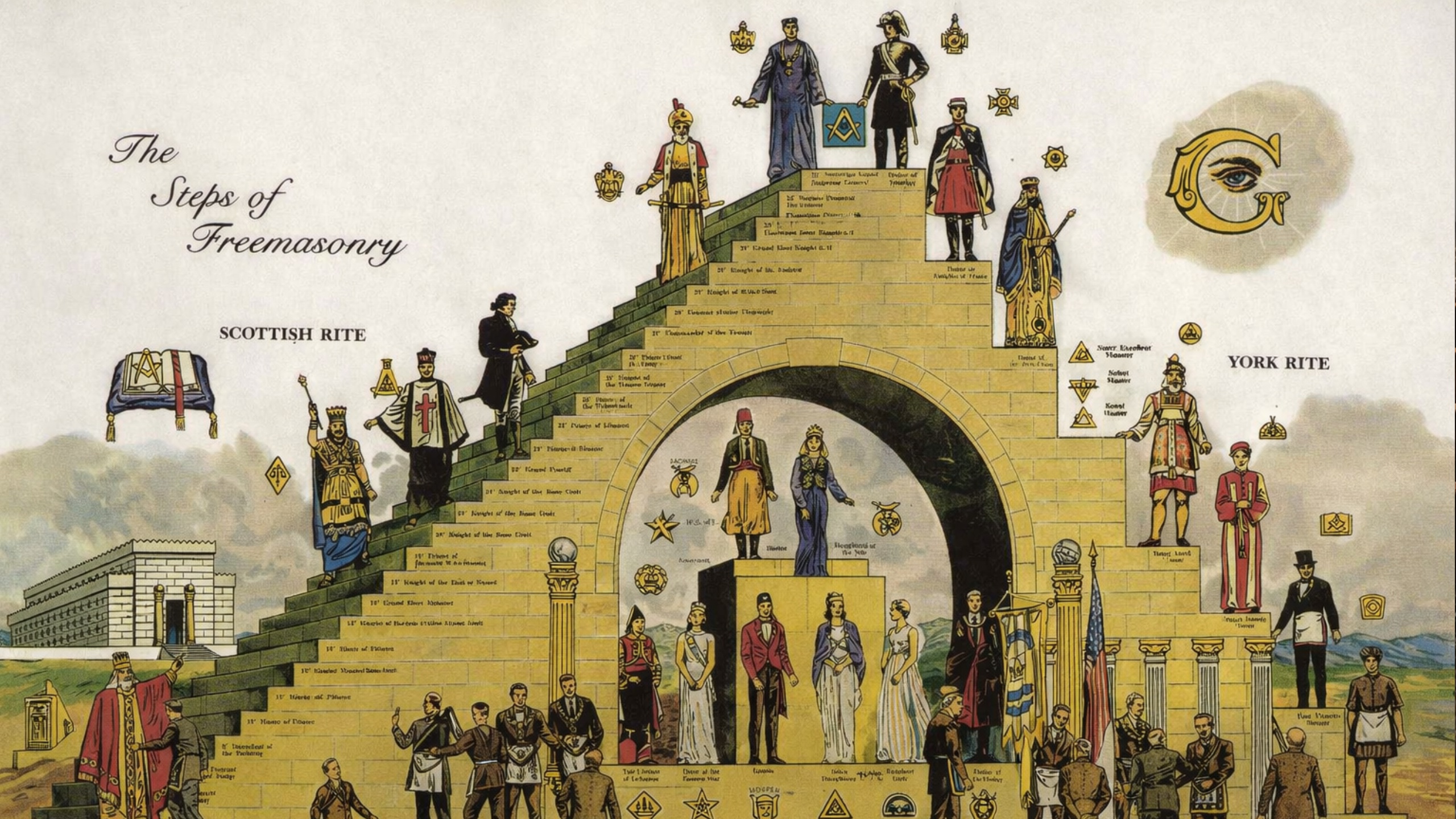
Freemasonry developed as a fraternal system emerging from medieval guild traditions, evolving into a structured order emphasizing ritual, hierarchy, symbolism, and moral instruction. By the eighteenth and nineteenth centuries, it had become embedded in Western civic life, particularly in Europe and the United States, where lodges functioned as social networks for businessmen, politicians, clergy, and community leaders. Within Freemasonry, additional bodies such as the Scottish Rite expanded the system through graded degrees, allegorical instruction, and symbolic narratives intended to convey moral and philosophical lessons rather than explicit theological doctrine.
Despite its public emphasis on morality and fraternity, Freemasonry has long been controversial within Christian theology. Many Protestant, evangelical, and fundamentalist theologians have objected to Masonry on the grounds that its oaths, secrecy, and religious inclusivism conflict with exclusive Christian confession. Critics argue that requiring members to affirm a generalized deity rather than the triune God of Christian orthodoxy undermines the uniqueness of Christ, while others object to ritual language that places moral enlightenment and personal virtue alongside or above redemption through Christ alone. These concerns were articulated repeatedly in sermons, pamphlets, and books throughout the nineteenth and twentieth centuries.
Alongside theological objections, Freemasonry has also been the subject of persistent conspiracy theories. These range from claims of covert political control to allegations of occultism, Luciferian symbolism, or secret coordination with other fraternal bodies. While many such claims rely on speculation or misinterpretation of symbolic language, their persistence reflects the tension created by secrecy, ritualized knowledge, and layered degrees—features that make Freemasonry opaque to outsiders. In periods of social unrest, these suspicions intensified and were frequently projected onto other fraternal orders, including the Ku Klux Klan, which consciously modeled itself on lodge structures.
This background is essential for understanding how fraternal culture functioned in early twentieth-century America and why overlaps between Freemasonry, the Ku Klux Klan, and religious movements drew both acceptance and alarm. The objections raised by Christian critics were not abstract theological disputes but responses to real social systems in which church leaders, politicians, and fraternal organizations often intersected. These dynamics form the context in which William Branham’s environment, associations, and symbolic language must be examined.
Fraternal Orders in Early Twentieth-Century America and Their Overlap With Churches and Political Movements
In the late nineteenth and early twentieth centuries, fraternal organizations were a normalized part of civic life in the United States. Lodges such as the Independent Order of Odd Fellows and Masonic bodies functioned as social networks that blended ritual, hierarchy, mutual aid, and moral instruction. Membership often overlapped with local leadership in business, politics, and churches, creating an environment in which fraternal affiliation carried social legitimacy rather than suspicion. In many communities, lodge officers and church leaders were drawn from the same pool of respected men, and participation in fraternal orders was not viewed as contradictory to religious involvement.
This fraternal culture also shaped explicitly political and extremist movements. The Ku Klux Klan of the early 1920s consciously adopted the structure, terminology, and secrecy of lodge systems, presenting itself as a patriotic fraternity rather than merely a vigilante organization. Public defenses of the Klan frequently relied on this framing. Congressman William D. Upshaw argued that scrutiny of the Ku Klux Klan should be accompanied by investigations of all secret orders, explicitly positioning the Klan within the broader and socially accepted world of fraternal organizations rather than as an isolated phenomenon [1][2]. This rhetoric reflected an environment in which fraternal affiliation served as a shield, normalizing secrecy and ritual as commonplace features of American civic life.
Within religious communities, the overlap was similarly visible. Newspaper records document figures later associated with William Branham’s inner circle holding offices in fraternal lodges long before their roles in church leadership. George DeArk, who later served as an elder, is listed as an officer and delegate within the Independent Order of Odd Fellows [4][5]. Likewise, Sante Davison, identified in later years as an elder connected to Branham’s ministry, appears in lodge photographs and reports as an officer of a local Odd Fellows lodge [6]. These records demonstrate that fraternal participation among Branham’s associates was neither incidental nor unusual but reflective of a broader pattern in which lodge membership and church leadership coexisted without perceived conflict.
Understanding this social landscape is critical for evaluating later claims about Masonic or fraternal influence within Branhamism. The presence of fraternal ties does not, by itself, establish doctrinal dependence, but it does show that Branham’s formative environment was one in which lodge structures, secrecy, ritual symbolism, and hierarchical organization were familiar and socially validated. This normalization created fertile ground for religious movements to adopt similar organizational patterns without immediately triggering resistance from their communities.
Roy E. Davis as Branham’s Mentor: Ku Klux Klan Leadership, Fraternal Structure, and Masonic Overlap
Roy E. Davis played a formative role in William Branham’s early ministerial development, functioning not merely as an associate but as the minister who baptized, pastored, ordained, and publicly introduced Branham into Pentecostal ministry [10][11]. Davis himself repeatedly emphasized this relationship, stating that he received Branham into the first Pentecostal assembly he ever attended, baptized him, served as his pastor for approximately two years, and preached his ordination sermon [11].
At the same time, Davis was deeply embedded in the leadership structure of the Ku Klux Klan during its twentieth-century resurgence. Contemporary newspapers identify Davis as holding senior offices within the Klan and related successor organizations, including public claims that he possessed all degrees of the Klan and participated in drafting its constitution, by-laws, and ritual when it was revived in 1915 [12]. Other reports describe Davis as a principal organizer and recruiter, asserting personal responsibility for enlisting large numbers of members and serving as an ambassador and spokesman for the organization [13][14].
The Ku Klux Klan under Davis and his contemporaries deliberately modeled itself on fraternal orders. Its graded degrees, ritual language, secret oaths, titles, and hierarchical command structure were consciously patterned after lodge systems already familiar in American civic life. Davis’s public defenses of the Klan framed it as a legitimate fraternity rather than an extremist movement, positioning it alongside other secret orders as part of an accepted organizational culture [12][13]. This normalization strategy relied on the assumption that fraternal secrecy and ritual authority were already socially validated.
This fraternal framing is significant for understanding the environment in which Branham was mentored. Davis embodied a model of authority rooted in hierarchy, loyalty, initiation, and insider knowledge. The same individual who baptized and ordained Branham was simultaneously advancing a lodge-based system of power that blurred religious language with fraternal identity. This convergence of religious mentorship and fraternal organizational logic formed part of the social and institutional context from which Branham’s ministry emerged.
Congressman William D. Upshaw: Defense of the Klan, Exposure of Membership, and Support of Branham's Revivals
Congressman William D. Upshaw of Georgia was a nationally visible figure whose religious activism, political career, and fraternal entanglements converged in ways that directly intersected with William Branham's ministry. During the early 1920s, as public scrutiny of the Ku Klux Klan intensified, Upshaw positioned himself as a defender of the organization by reframing congressional investigations as discriminatory. He publicly argued that Congress should investigate "each and every secret organization in the United States," insisting that the Klan should not be singled out while other fraternal orders operated without interference [22][23]. This tactic deliberately embedded the Klan within the broader, socially accepted culture of lodges and secret societies.
Contemporary press accounts recorded Upshaw's praise for Klan leadership and his insistence that calls for investigation were attacks on legitimate fraternal life rather than responses to extremist violence [22]. Shortly thereafter, newspaper reporting identified Upshaw himself as a member of the Ku Klux Klan, based on information originating from Klan headquarters and presented to investigative committees [24]. The exposure of his membership clarified that his threats to probe all fraternal orders functioned as a protective maneuver, leveraging the widespread participation of civic and religious leaders in secret societies to blunt focused scrutiny of the Klan.
Upshaw's influence extended well beyond politics into revivalist religion. Widely known as an evangelical speaker and prohibition advocate, he cultivated a public identity that blended moral reform with charismatic testimony. This religious persona later converged with William Branham's healing revivals. Branham repeatedly cited Upshaw as a prominent figure whose healing validated his ministry, recounting that Upshaw—crippled for decades—was healed during Branham's meetings and subsequently appeared publicly at his revival services [25][26][27]. Branham framed this event as divinely revealed and emphasized Upshaw's status to reinforce the credibility of the healing claim [25][27].
Mainstream press coverage corroborated Upshaw's visible participation in Branham's revivals, reporting that he walked to the pulpit where Branham was conducting services and attributing his recovery to those meetings [28]. Through this association, Upshaw functioned as a bridge figure linking fraternal politics, prohibitionist activism, and faith-healing revivalism. His public defense of the Klan, later exposure as a member, and subsequent endorsement of Branham's ministry illustrate how fraternal loyalty, political influence, and religious authority reinforced one another within the same social network.
This convergence is critical for understanding the legitimacy afforded to Branham's revivals. Upshaw's stature as a former congressman and moral reformer provided social capital that insulated Branham's ministry from scrutiny, even as Upshaw himself exemplified the fraternal strategies used to normalize secrecy, hierarchy, and insider allegiance across political and religious spheres.
Branham’s Acknowledged Indebtedness to the Ku Klux Klan and Freemasons
William Branham publicly acknowledged receiving direct material assistance from both the Ku Klux Klan and Freemasons during a period of personal crisis, framing this aid as a debt of gratitude that shaped his attitudes toward those organizations. In a 1963 sermon, Branham stated explicitly that the Ku Klux Klan paid his hospital bill and immediately linked this assistance to Freemasons, expressing that he could never forget what they had done for him regardless of later actions or controversies [29]. This statement is significant because it was not offered as a rumor or third-party claim, but as Branham’s own explanation of his moral obligation toward these groups.
Branham’s language reveals more than incidental charity. By naming the Klan and the Masons together in the same breath, he implicitly situated them within the same moral category of benefactors. The phrasing indicates an assumed overlap or close association between the two in his local environment, reinforcing the documented reality that fraternal and extremist organizations often shared members, resources, and social networks. Branham’s admission demonstrates that his relationship to these groups was not merely observational but involved tangible support that he believed carried lasting personal significance [29].
This acknowledgment helps explain Branham’s consistent reluctance to condemn either organization publicly, even when distancing himself rhetorically from aspects of their ideology. The sense of indebtedness he articulated aligns with fraternal norms emphasizing loyalty, gratitude, and obligation to those who render aid. Within such systems, material assistance is not morally neutral but establishes enduring bonds that shape future allegiances and silences criticism.
Placed alongside Branham’s close association with Roy E. Davis and his later promotion by figures such as William D. Upshaw, this admission completes a pattern. It shows that Branham’s ministry developed within a network where fraternal loyalty, political extremism, and religious authority intersected. The acknowledgment of financial aid from the Klan and Masons therefore functions as a critical data point, demonstrating not only ideological proximity but practical dependence within the same social ecosystem.
Symbolic Architecture and Fraternal Continuity at the Branham Tabernacle
The physical structure and visual symbolism of the Branham Tabernacle place the congregation within a regional civic culture where fraternal imagery and lodge identity were common and publicly displayed. A photograph of the tabernacle facade shows a five-pointed star (pentagram) mounted above the entrance, positioned between the words “Branham” and “Tabernacle” [30]. The star is not presented upright, but appears rotated, which makes the symbol visually consistent with the fraternal-style emblem of the Masonic Order of the Eastern Star, rather than a neutral decorative star.
Because fraternal organizations used exterior symbols as identifiers, such placement functioned as a public signal while still allowing ambiguity for outsiders. In this context, the pentagram above the tabernacle entrance operates as an architectural marker that can be read in continuity with the broader lodge-and-order environment surrounding Branham’s early ministry. Regardless of whether the symbol was ever explained to congregants, the photograph documents that the church building adopted a form of signage that overlaps with the visual grammar of fraternal culture in the same period [30].
This architectural symbolism matters because Branham’s movement repeatedly relied on insider framing, selective access to “mysteries,” and loyalty structures that parallel fraternal patterns. The star above the entrance therefore serves as a tangible, photographically documented point of continuity between Branham’s sacred space and the wider fraternal world shaping public life in his region [30].