
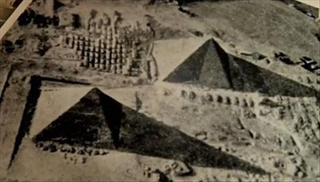
Pyramid
William Branham taught that the Great Pyramid of Giza was spiritually significant and perfectly mapped the years to his various doomsday predictions. The Gospel of the Pyramid was closely tied to his Zodiac teachings and was the foundation for Branham's version of rapture theology. Many additional doctrines were built on top of this foundation. It was not widely accepted, however, and Branham was careful to avoid teaching the doctrine when speaking to specific audiences. In some cases, Branham denied teaching it when certain people were present in his revivals or church services.[1] Other times, Branham claimed that the Great Pyramid of Giza and the Zodiac were the first and the second Bible.
William Branham taught that the Great Pyramid of Giza was spiritually significant and perfectly mapped the years to his various doomsday predictions. The Gospel of the Pyramid was closely tied to his Zodiac teachings and was the foundation for Branham's version of rapture theology. Many additional doctrines were built on top of this foundation. It was not widely accepted, however, and Branham was careful to avoid teaching the doctrine when speaking to specific audiences. In some cases, Branham denied teaching it when certain people were present in his revivals or church services.[1] Other times, Branham claimed that the Great Pyramid of Giza and the Zodiac were the first and the second Bible.
What's He doing? He is writing His first Bible. The first Bible was ever written, was written in the skies, the Zodiac. It starts out with the virgin, that's how He come first. It ends up with Leo the lion, the second Coming. And He is writing His first Bible. 44 The second Bible was written, was written by Enoch, and put in the pyramid.[2]
Branham claimed that the pyramid was the time marker for the world's doomsday clock, and in the mid-1950s began claiming that the clock had reached the pyramid's "King's Chamber," signifying the end.[3] Almost seventy years later, most leaders in Branham's cult either try to explain why the "doomsday clock" failed or attempt to conceal this doctrinal teaching from their congregations.
One of the more unusual doctrines that William Branham introduced into the Latter Rain Revivals was that of the "Capstone of the Pyramid." Built upon his doctrine that the Great Pyramid of Giza was God’s second Bible, Branham claimed that the top of the pyramid symbolically represented Jesus. Repurposing a passage from Psalm 118 mentioned by Jesus in Mark 12, Branham claimed that the "stone that the builders rejected" was both Jesus and the pyramid's capstone.
But notice in building the pyramid…Now, watch this. You got a dollar bill in your pocket? I—I think I got one. So if you notice on the back of your dollar bill, why have they got the pyramid says, 'The Great Seal?' You ever notice it on your American dollar? Um-hum. 'The Great Seal.' Notice on that pyramid also, how it starts at the bottom and keeps coming up like this, minority, minority. And did you notice, the capstone's not even on it. Neither is the pyramid capped. Why? The Capstone was rejected, Jesus Christ, the Head of it, exactly right.[4]
Besides the obvious problems with claiming that the tomb of Khufu was in any way related to Christianity, there is also an archeological problem with Branham’s extra-biblical claim: The “capstone” of the Great Pyramid of Giza is not believed to have been rejected. This claim was possible only through a sleight-of-hand technique. Because the Giza pyramid's capstone has never been found, the "religious" pyramidologists of the late 1800s and early 1900s claimed that the Khufu pyramid never had a capstone — purposefully avoiding mentioning that many other, smaller pyramids were missing their capstones. Like the Great Pyramid of Giza, some of the others also have never been found. This claim, while unprovable, does not match the pattern of the Egyptians and their usage of "miniature obelisks" to cap the structures devoted to the sun god. Interestingly, "Christian" pyramidologists do not consider the other capstones to be spiritually significant.
The ancient Egyptians used the stone to honor Atum, the supreme sun god of creation. "Ben-benet", the name for the capstones used by the ancients, was named after the sacred Ben-ben stone in Heliopolis, the oldest city of sun god worship.[5] During the Old Kingdom, the "pyramidions" (capstones) were typically made of diorite, granite, or fine limestone covered in gold or electrum. By the Middle Kingdom and the end of the Pyramid Age, they were typically made of granite and inscribed with hieroglyphs.[6] Few, if any, of the pyramidions survived[7] the grave robbers and harsh conditions of the desert. When any pyramidions are discovered, they are seldom found at the top of a pyramid.[8] Those that survived and were found have been moved to the Egyptian Museum in Cairo for conservation reasons.[9]
The worship of the Khufu pyramid in pseudo-Christianity originated with the works of C. Piazzi Smyth, who invented the "pyramid inch" (deviating from the English measurement) and claimed that the tunnels of the Great Pyramid held significant spiritual meaning. Smyth believed that the descendants of the Biblical Adam built the Pyramid for a divine purpose.[10] Smyth's works were popularized in the United States through C. A. L. Totten, the foremost British Israelite in the United States at the time. Smyth and Totten collaborated on books and publications mapping out this "divine purpose"[11] as it related to predicting the End of Days.
After Smyth's death and as British Israelism began to transition into Christian Identity, David Davidson became the central figure of religious pyramidism. Davidson's book, The Great Pyramid: Its Divine Message and his many other books and publications solidified the movement's belief in a "gigantic prophetic clock" that displayed sacred history through its measurements and architectural design.[12] That design could only have one purpose: to declare to the world that the end was nigh.
The pyramid functioned for many British-Israelites as a gigantic prophetic clock, in which sacred history was displayed by the length and configuration of its internal passageways. In this system, one 'pyramid inch' (which deviated one one-thousandth from the British inch) equaled one year. This equipped British-Israelism with a mechanism familiar to other millenarians, a system of date setting, by which the proximity of apocalyptic events could be precisely ascertained. In the early twentieth century, when this literature reached its greatest influence, some in the movement's umbrella organization, the British-Israel World Federation, attempted to suppress date setting, on the ground that 'the exact date of our Lord's appearing... is known to God ... yet the precise time is hidden, and probably will be till the end.'[13]
- Barkun, Michael. Religion and the Racist Right
William Branham's "Pyramid Bible" and "Zodiact Bible" doctrines were commonly believed among converts to the British Israel doctrine long before he introduced them to the Latter Rain movement. Key figures in Branham's campaigns were supporters and promoters of British Israelism, including Gordon Lindsay, who spoke at conferences for the Anglo-Saxon Federation of America.[14] British Israel converts adopted the pyramidism doctrines of John Taylor, who published The Great Pyramid in 1859. Taylor mistakenly believed that the Pyramid was constructed using the English inch-based measurement system, and developed absurd mathematical calculations to prove it. Eventually, British Israelites came to believe that the Pyramid was an ancient "Bible" of sorts, mapping out the timeline for the final destruction of the world systems.