
Seven Mountain Mandate
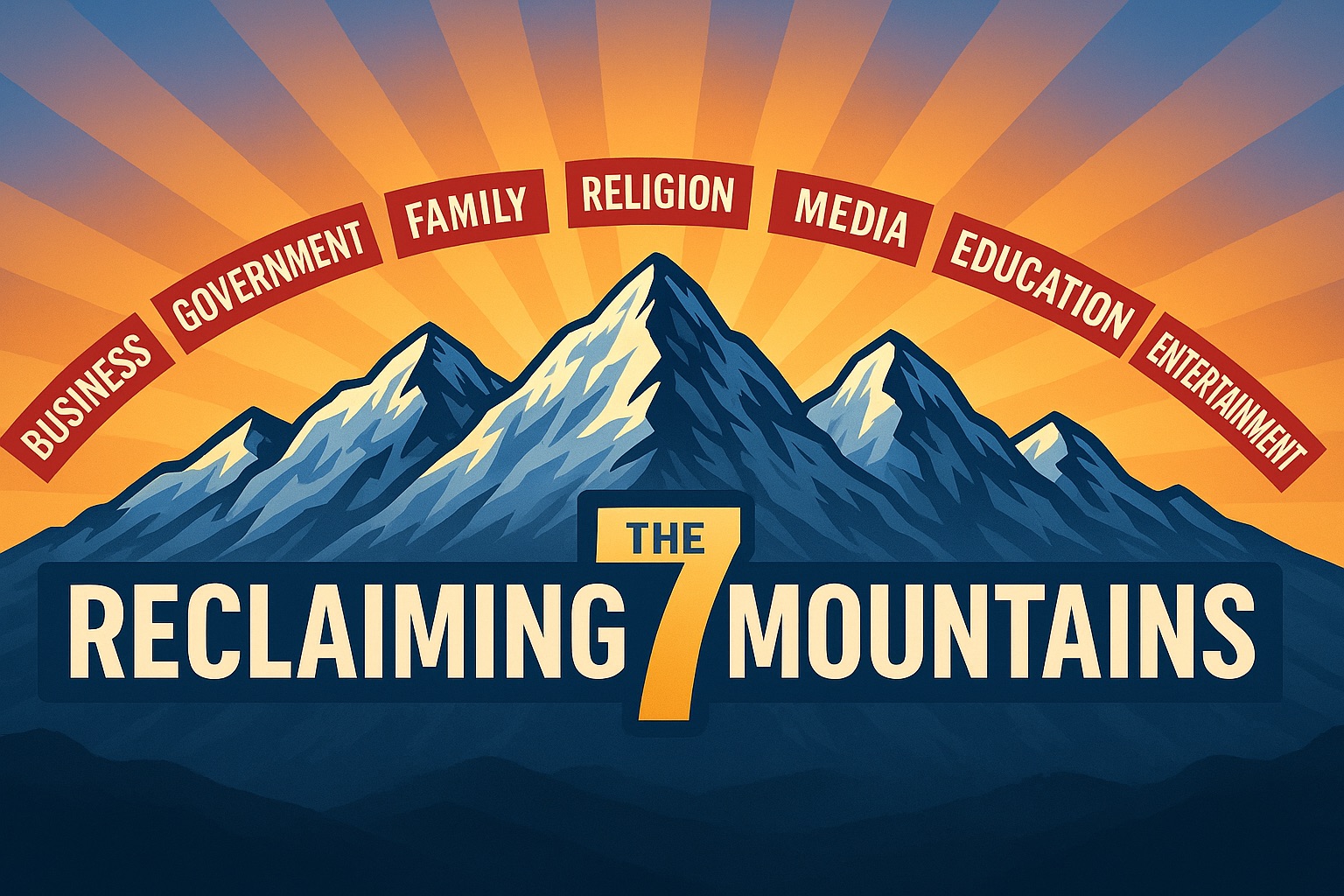
The Seven Mountain Mandate is a controversial ideology that has gained traction within certain sectors of the Charismatic and Pentecostal movements, particularly among proponents of the New Apostolic Reformation. Popularized by figures like Lance Wallnau and Bill Johnson, the mandate claims that Christians are called to seize control of seven critical spheres of influence in society: Religion, Family, Education, Government, Media, Arts and Entertainment, and Business. Proponents argue that by taking over these "mountains," Christians can impose their values on society and bring about a new world order rooted in Christian dominion.
At its core, the Seven Mountain Mandate is a dominionist agenda, seeking to place Christians in positions of power and authority across all sectors of life. This ideology reflects a theocratic vision in which secular governance and pluralistic values are replaced by a system dominated by Christian leaders who enforce their interpretations of biblical law. The underlying belief is that Christians are divinely mandated to occupy leadership roles in these spheres to trigger a global revival and establish God's kingdom on earth.
The mandate's origins can be traced back to the Latter Rain movement, which promoted the idea of a restored church, led by modern-day apostles and prophets. This laid the groundwork for dominion theology, and over time, developed into the idea that these so-called apostles and prophets would take control of global institutions. In recent years, the Seven Mountain Mandate has become a key part of the NAR's broader efforts to influence politics and culture, often encouraging its followers to pursue positions of power aggressively.
Critics of the Seven Mountain Mandate argue that it is a thinly veiled attempt to undermine democratic values and religious freedom by pushing for Christian supremacy. They see it as a dangerous and authoritarian vision that seeks to erode the separation of church and state. Instead of fostering positive influence, detractors claim it promotes an exclusionary and oppressive worldview, where dissenting beliefs and practices are marginalized under the guise of spiritual revival.
Youth With a Mission founder Loren Cunningham is credited with co-developing the concept of the "Seven Mountain Mandate." Cunningham was raised in a Pentecostal family deeply tied to the Assemblies of God. His early life immersed in charismatic teachings influenced the direction of his ministry, and Cunningham worked with Assemblies of God churches that strongly supported William Branham[1] and the other Latter Rain evangelists, such as Calvary Temple.[2]
Branham, who spearheaded the Latter Rain movement, was deeply connected to and held early revivals[3] with leaders of Christian Identity and white supremacy, one of whom founded the Supreme Kingdom organization. Caleb Ridley, the Klan's supreme religious chaplain, attempted to conquer government and education during the late 1920s and worked closely with Branham's mentor, Roy Davis,[4] the former official spokesperson and second-in-command for the Klan.[5] Many Latter Rain leaders, such as F. F. Bosworth, were strong supporters of British Israelism, the belief that Great Britain and the United States were descendants of the lost ten tribes of Israel destined to reign. Bosworth was a ranking member of John Alexander Dowie's cult in Zion, Illinois, and had worked with Dowie in an attempt to establish a theocracy in the United States. After Dowie's cult imploded, Bosworth joined the sect of Parhamites, founded by Pentecostal leader Charles Fox Parham, who had been influenced by the British Israelism and early Christian Identity doctrines of C. A. L. Totten through Frank Sandford's communal city and Christian training center of Shiloh.[6] Bosworth went on to help found the Assemblies of God organization, from which Cunningham received his early Christian fundamentals.
During the 1950s, after Christian Identity had merged with Christian Nationalism to breed a more militant form of Christianity, Latter Rain leaders became very outspoken against the United States Government. Branham and other Christian Identity leaders had strongly opposed President Roosevelt. They were spreading propaganda about a secret plot by Roosevelt and the Catholic Church to convert the United States to Catholicism[7] as part of a greater Jewish conspiracy. In 1951, then-Representative John F. Kennedy began pushing legislation to establish a group of "young college graduates" who "would find a full life in bringing technical advice and assistance to the underprivileged and backward Middle East."[8] In Kennedy's vision, "these men would follow the constructive work done by the religious missionaries in these countries over the past 100 years." Other leaders in the Democratic party supported Kennedy's motion, including Senator Brien McMahon, who proposed an "army" of young Americans to act as "missionaries of democracy." In 1957, Democratic Senator Hubert Humphrey introduced the first bill to create the Peace Corps to bring Kennedy's vision to reality.[9]
Cunningham's Youth With A Mission organization was the Christian Right's answer to Kennedy's initiative. YWAM's mission, much like that of the Peace Corps, aimed to spread evangelical Christianity through youth missionaries at a faster pace than democracy could spread through the Peace Corps. In 1960, the same year William Branham began targeting Kennedy as a threat to the Christian Right,[10] Cunningham formally established YWAM. This put youth in the field almost a full year before President Kennedy's Executive Order 10924, which authorized the Peace Corps to begin its mission. Until Kennedy's assassination in November 1963, Branham and other Christian Identity leaders frequently compared Kennedy and the First Lady to the Biblical figures Ahab and Jezebel.[11]
Cunningham's Youth With A Mission organization was the Christian Right's answer to Kennedy's initiative. YWAM's mission, much like that of the Peace Corps, aimed to spread evangelical Christianity through youth missionaries at a faster pace than democracy could spread through the Peace Corps. In 1960, the same year William Branham began targeting Kennedy as a threat to the Christian Right,[10] Cunningham formally established YWAM. This put youth in the field almost a full year before President Kennedy's Executive Order 10924, which authorized the Peace Corps to begin its mission. Until Kennedy's assassination in November 1963, Branham and other Christian Identity leaders frequently compared Kennedy and the First Lady to the Biblical figures Ahab and Jezebel.[11]